Restaurant robots are moving into tasks that repeat for hours: carrying trays, moving food, cleaning floors, and preparing simple orders. The appeal is practical. A robot can take on a narrow job while staff handle work that needs judgment, care, or direct contact with guests.
Quick read
- Robots fit best where the same route or motion repeats many times.
- They still need floor space, setup, cleaning, and human oversight.
- The useful question is the cost per task, not the robot’s novelty.
The work restaurants want to hand over
A busy restaurant contains many small jobs that consume time without needing much decision-making.
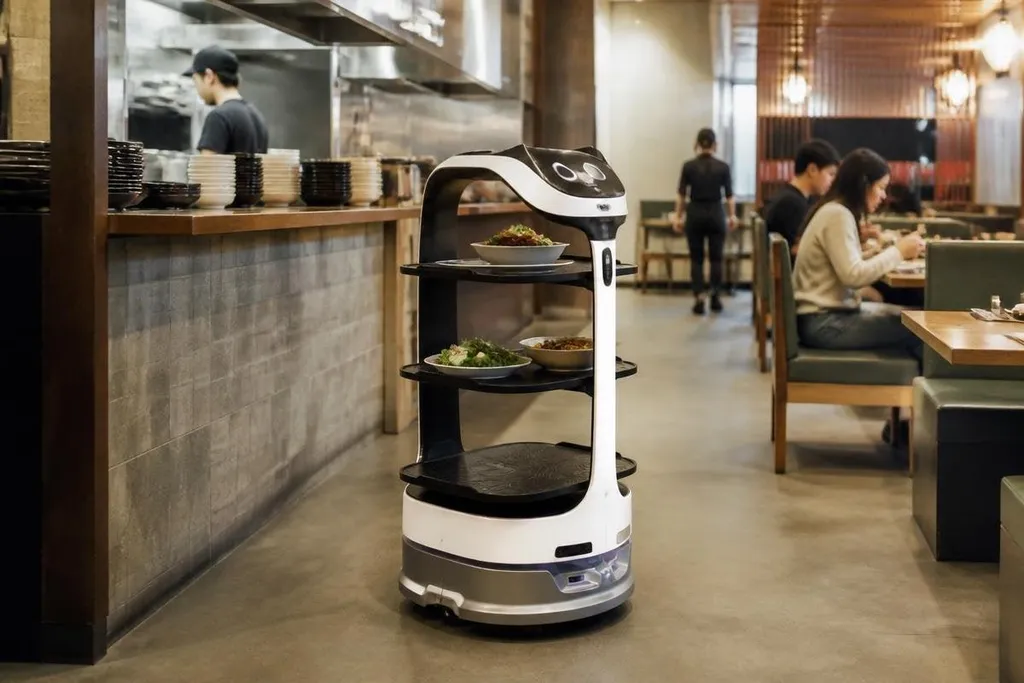
A delivery robot can move meals from a kitchen to a table. A floor robot can follow a mapped route after closing. A robotic arm can repeat a fixed movement at a prep station.
That division matters because restaurant work changes from minute to minute. A server may need to answer a guest’s question, carry several plates, and notice a spill on the same trip. These systems work better when the task has clear rules and a stable path.
The same rule applies in the kitchen. Robots have a better chance with a fixed container, fixed pickup point, or repeated transfer than with food that changes shape, temperature, or position. Human hands still handle many tasks where the robot must judge texture, fit, or presentation.
Why interest is growing
Labor cost is one reason, but the wider issue is scheduling. A restaurant needs enough people during busy periods, then has less work at quieter times. A robot may cover a repeated task across that schedule without changing the rest of the team’s duties.
That does not make the robot free labor. The restaurant still needs to buy or rent the system, prepare the floor, charge it, clean it, and fix faults. Staff may also need time to move tables, clear paths, or take over when a route is blocked.
The best use case often starts with a task that already causes delays. If staff spend part of every shift walking meals across a large dining room, a delivery robot may cut that walking. If cleaning waits until the last staff member leaves, an autonomous floor robot may let the work start sooner.
Restaurant robots face the same test as warehouse machines: can they work in a busy dining room without constant staff help? Restaurant robotics reporting from Robot24.com can show how floor plans and changing tasks affect the result. Those limits lead to the next question: where do restaurant robots still struggle?
What still limits restaurant robots
Restaurants are difficult places for autonomous systems. People move without warning, chairs shift, bags sit in walkways, and doors may open into a robot’s path. A machine that works well on a clear floor can slow down when the room changes around it.
Food also creates special problems. Grease, spills, heat, steam, and crumbs can affect sensors and moving parts. A system that carries meals must be easy to clean, and its design must fit the restaurant’s food-safety process.
Guest response matters too. Some diners may welcome a robot carrying a meal. Others may still expect a person to check the table, answer questions, or handle a problem. The robot has to fit the service style instead of forcing staff to work around it.
I’d be cautious about any purchase based on a smooth demonstration alone. Ask what happens when the lift is full, a child blocks the path, the battery runs low, or a staff member needs the machine out of the way.
A practical buying check
Before a restaurant tests a robot, the manager should check:
- Name the task: record who does it now and how often it repeats.
- Measure the route: note door widths, floor changes, lifts, tables, and blocked paths.
- Price the full setup: include the robot, software, charging, service, training, and cleaning.
- Set a human handoff: decide who takes over when the machine stops or needs help.
- Run a small trial: compare task time, staff time, faults, and guest complaints.
- Check the exit plan: confirm how the restaurant can stop renting or service if results stay poor.
This process keeps the decision tied to a real task. It also shows where a low-cost layout change or better staff routine may solve the same delay.
Restaurant robots are becoming more useful as their jobs get narrower and their surroundings get easier to control. The next test is not whether a machine can move through a dining room once. It is whether it can repeat the job for a full service period, with people, spills, and blocked paths included.